
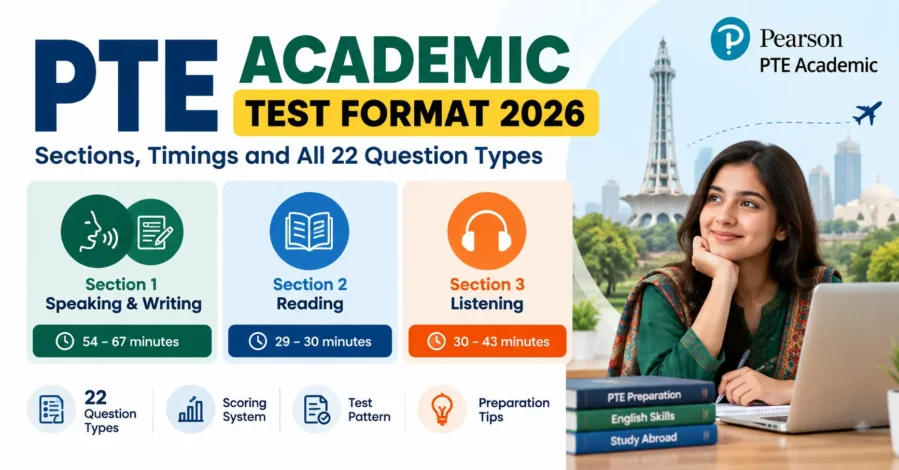
If you’re planning to take the PTE Academic test, you probably have several questions. How long is the exam? What happens in the speaking section? How many questions will you face, and which mistakes can cost you marks?
Understanding the PTE test format before you begin preparing can make a real difference. It helps you concentrate on the right skills, manage your time and avoid unpleasant surprises on test day.
There is also an important update to know about. Pearson introduced two additional speaking question types in August 2025, increasing the total from 20 to 22. These changes remain part of the PTE Academic test pattern in 2026.
This guide explains all three sections, every question type, the scoring system and the practical steps Pakistani students should take before booking their examination.
What Is the PTE Academic Test?
The Pearson Test of English Academic, commonly called PTE Academic, is a computer-based English proficiency test conducted by Pearson.
It measures your ability to use English in academic and everyday situations through four language skills:
- Speaking
- Writing
- Reading
- Listening
PTE Academic is accepted by many universities and educational institutions worldwide. It is also accepted for certain visa, migration and professional registration purposes, depending on the receiving authority.
Unlike a traditional speaking interview, PTE Academic uses a computer and microphone to record your responses. You read instructions on a screen, listen through headphones and type answers using a keyboard.
The examination lasts approximately two hours, and your performance is reported on a score scale of 10 to 90.
If you’re still deciding which English test to take, our IELTS vs PTE comparison for Pakistani students explains the differences in test format, speaking assessment, scoring and preparation.
PTE Test Format 2026: Quick Overview
PTE Academic consists of three sections, 22 scored question types and approximately 65–75 questions. The examination takes around two hours and assesses all four English language skills.
Here is the current examination structure.
| Exam detail | PTE Academic format |
|---|---|
| Test name | Pearson Test of English Academic |
| Conducted by | Pearson |
| Exam mode | Computer-based |
| Total duration | Approximately 2 hours |
| Main sections | 3 |
| Question types | 22 |
| Total questions | Approximately 65–75 |
| Speaking and Writing | 76–84 minutes |
| Reading | 23–30 minutes |
| Listening | 31–39 minutes |
| Score range | 10–90 |
| Results | Usually within 2 business days |
| Score validity | Generally 2 years |
The test always follows the same section order: Speaking and Writing first, Reading second and Listening last.
The number of questions and individual section durations can vary slightly between test versions.
Why Are There Three Sections but Four Skills?
Although PTE assesses four English skills, it organizes questions into three main parts.
Speaking and Writing are combined in the first section. Reading forms the second section, followed by Listening.
Some questions also assess two skills simultaneously. For example, Repeat Sentence measures listening and speaking, while Write from Dictation contributes to listening and writing.
These are called integrated-skills questions.
What Changed in the PTE Exam Format for 2026?
The latest major format update took effect on 7 August 2025. The revised structure continues to apply in 2026.
Pearson retained the original 20 question types and introduced two new speaking tasks.
1. Summarize Group Discussion
You listen to three people discussing a topic and then explain the discussion in your own words.
This task assesses how accurately you understand the speakers, identify their viewpoints and organize information into a spoken summary.
2. Respond to a Situation
You read and listen to a situation and explain what you would say in response.
For example, you may need to request assistance, explain a problem or respond politely to someone in an academic setting.
Both tasks require spontaneous spoken English rather than memorized answers.
Previous vs Current PTE Academic Pattern
| Feature | Previous format | Current format |
|---|---|---|
| Scored question types | 20 | 22 |
| Speaking tasks | Original tasks | Two additional speaking tasks |
| Summarize Group Discussion | Not included | Included |
| Respond to a Situation | Not included | Included |
| Scoring range | 10–90 | 10–90 |
| Main sections | 3 | 3 |
| Overall duration | Approximately 2 hours | Approximately 2 hours |
Pearson also introduced expanded human review of selected written and spoken responses.
Important: If you’re using PTE preparation videos or practice materials published before August 2025, check whether they include both new speaking tasks.
You can verify the changes through Pearson’s official PTE Academic updates.
Section 1: PTE Speaking and Writing Format
Duration: 76–84 minutes
Speaking and Writing is the first and longest part of the PTE Academic examination.
It contains nine question types, covering pronunciation, oral fluency, listening comprehension, written summaries and essay writing.
| Question type | Main skill assessed | Task |
|---|---|---|
| Read Aloud | Speaking | Read a passage aloud |
| Repeat Sentence | Listening and Speaking | Repeat a spoken sentence |
| Describe Image | Speaking | Describe visual information |
| Retell Lecture | Listening and Speaking | Summarize a short lecture |
| Answer Short Question | Listening | Provide a brief factual answer |
| Summarize Group Discussion | Listening and Speaking | Summarize three speakers’ discussion |
| Respond to a Situation | Speaking | Give an appropriate spoken response |
| Summarize Written Text | Reading and Writing | Write a one-sentence summary |
| Write Essay | Writing | Write a 200–300-word essay |
Let’s look at what each task involves and how you should approach it.
Personal Introduction: Before the Scored Questions
The first activity is the Personal Introduction.
You have 25 seconds to prepare and 30 seconds to introduce yourself through the microphone.
You could briefly mention your name, education or reason for taking the examination.
This activity is intended to familiarize you with the test interface and recording process.
Your Personal Introduction does not contribute to your PTE score.
1. Read Aloud
In Read Aloud, a short passage appears on the screen. You must read the text clearly into your microphone.
You normally receive 30–40 seconds to prepare before recording begins.
Practice example:
“Technology has changed the way students access educational resources. Online libraries, digital textbooks and learning platforms now allow students to study from almost anywhere.”
Read the complete passage using natural pronunciation, suitable pauses and a steady pace.
How to improve: Practise reading English paragraphs aloud every day. Pay attention to punctuation and word stress rather than trying to speak as quickly as possible.
You do not need to imitate a particular foreign accent. Focus on clear, understandable English.
2. Repeat Sentence
You hear a short sentence once and must repeat it as accurately as possible.
The task tests how well you understand spoken English and remember words in their correct order.
Practice example:
Audio: “The university will announce the examination results next Monday.”
Your response should reproduce the sentence as closely as possible.
A common problem is remembering the main words but missing smaller ones such as the, will and next.
How to improve: Listen to short recorded sentences and repeat them immediately. Gradually increase the sentence length.
3. Describe Image
An image appears on the screen, and you must describe it aloud.
The image may be a chart, graph, map, diagram, process or photograph.
You have approximately 25 seconds to prepare and 40 seconds to speak.
Practice example:
Suppose a bar chart compares university enrolments:
| Year | Students enrolled |
|---|---|
| 2022 | 2,000 |
| 2023 | 2,500 |
| 2024 | 3,200 |
A natural response could be:
“The bar chart shows university enrolment from 2022 to 2024. Student numbers increased throughout the period, rising from 2,000 in 2022 to 2,500 in 2023. Enrolment reached its highest level in 2024, with 3,200 students. Overall, the chart shows consistent growth.”
Notice that the answer identifies the topic, gives important figures and explains the overall trend.
How to improve: Practise describing what the image actually shows. Avoid repeating a generic template without including meaningful information.
4. Retell Lecture
You listen to a short academic lecture and summarize the main points aloud.
After the recording, you have 10 seconds to prepare and 40 seconds to respond.
Example:
Imagine the lecture explains how climate change affects agriculture.
The speaker discusses rising temperatures, changing rainfall patterns and the importance of efficient irrigation.
A strong response would explain these connected ideas instead of mentioning random words from the recording.
How to improve: Take short notes while listening. Record the central topic, two or three supporting points and the lecturer’s conclusion.
5. Answer Short Question
In this task, you listen to a brief question and answer using one word or a few words.
Practice examples:
| Question | Answer |
|---|---|
| What device measures temperature? | Thermometer |
| What do plants absorb from the atmosphere during photosynthesis? | Carbon dioxide |
| How many days are in a week? | Seven |
| What is the opposite of expensive? | Cheap |
| What do we call someone who studies stars and planets? | Astronomer |
Although you speak your answer, Pearson scores this task as a Listening question.
How to improve: Listen carefully and answer directly. You do not need to explain your reasoning unless the question requires it.
6. Summarize Group Discussion — New PTE Question Type
Summarize Group Discussion is one of the two question types added in August 2025.
You hear a discussion involving three people. The recording may last up to three minutes.
After listening, you receive 10 seconds to prepare and two minutes to summarize the discussion.
Practice scenario:
Three students are discussing online education.
- The first student believes online learning saves time and travel expenses.
- The second student argues that classroom learning offers better interaction.
- The third student suggests combining online and classroom teaching.
Example response:
“The discussion focused on different approaches to university education. The first speaker supported online learning because it saves time and reduces travel expenses. The second speaker preferred classroom learning, highlighting the benefits of direct interaction with teachers and classmates. The third speaker suggested a blended approach that combines online flexibility with face-to-face learning. Overall, the speakers discussed how universities could balance convenience with effective student engagement.”
How to improve: Identify who said what, explain the relationships between their ideas and summarize them in your own words.
Do not simply repeat isolated phrases from the recording.
7. Respond to a Situation — New PTE Question Type
Respond to a Situation assesses how appropriately you can communicate in a realistic scenario.
You read and hear a description of a situation, receive 10 seconds to prepare and then have 40 seconds to speak.
Practice scenario:
You are a university student. Your assignment is due tomorrow, but your laptop has stopped working. You want to ask your teacher for a short extension.
Example response:
“Good morning, sir. I wanted to explain that my laptop stopped working yesterday, and I haven’t been able to complete the final part of my assignment. I have already finished most of the work, but I need a little more time to check and submit it properly. Would it be possible to have an extension until Friday? I would really appreciate your consideration.”
This response identifies the problem, makes a clear request and uses an appropriate tone.
How to improve: Understand the situation before speaking. Consider who you are addressing, what information must be communicated and whether the response should be formal or informal.
8. Summarize Written Text
You read a passage and summarize its main ideas in one complete sentence.
You have 10 minutes to complete each question.
The response must contain 5–75 words.
Practice example:
Original information:
“Regular physical activity improves cardiovascular health, strengthens muscles and supports mental well-being. Research also suggests that exercise can reduce stress and improve sleep quality.”
Possible summary:
“Regular physical activity supports physical and mental health by improving cardiovascular fitness, strengthening muscles, reducing stress and promoting better sleep.”
How to improve: Identify the main idea, select the strongest supporting points and combine them into one grammatically correct sentence.
Avoid adding information that is not supported by the passage.
9. Write Essay
Write Essay is the final question type in the Speaking and Writing section.
You have 20 minutes to write an essay of 200–300 words.
The topic usually requires you to discuss a viewpoint, evaluate an issue or explain your opinion.
Practice topic:
“Some people believe that university education should be free for everyone. Do you agree or disagree?”
A clear essay structure is:
| Paragraph | Purpose |
|---|---|
| Introduction | Introduce the topic and state your position |
| Body 1 | Explain your first argument |
| Body 2 | Present another argument with supporting evidence |
| Conclusion | Summarize your reasoning and position |
You could argue that free higher education increases access, but that governments must consider the cost of maintaining educational quality.
How to improve: Spend a few minutes planning, write focused paragraphs and leave time to check grammar, punctuation and word count.
An accurate, well-organized response is more useful than an essay filled with difficult vocabulary used incorrectly.
Section 2: PTE Reading Test Format
Duration: 23–30 minutes
The Reading section measures your ability to understand academic and general English texts.
It contains five question types, including multiple-choice questions, paragraph ordering and vocabulary-based exercises.
| Question type | What you must do |
|---|---|
| Fill in the Blanks (Dropdown) | Select missing words from menus |
| Multiple Choice, Multiple Answers | Select all correct options |
| Reorder Paragraph | Arrange sentences or paragraphs logically |
| Fill in the Blanks (Drag and Drop) | Drag suitable words into empty spaces |
| Multiple Choice, Single Answer | Choose one correct answer |
10. Fill in the Blanks (Dropdown)
You read a passage containing missing words. For each blank, you select the most appropriate word from a drop-down list.
Example:
“Students who regularly review their lessons are more likely to ___ information.”
Options: retain, remove, refuse, reduce
Correct answer: retain
The correct choice must make sense grammatically and within the passage.
Preparation tip: Learn common academic word combinations and pay attention to the meaning of surrounding sentences.
11. Multiple Choice, Multiple Answers
You read a passage and select every correct answer from the available choices.
More than one option may be correct.
This task includes deductions for incorrectly selected options.
Preparation tip: Choose answers supported by the passage. Avoid selecting extra options merely because they sound reasonable.
12. Reorder Paragraph
You receive several text boxes in the wrong order and must arrange them into a logical paragraph.
Example:
A. As a result, students can access learning materials from any location.
B. Digital libraries provide access to books, journals and academic databases.
C. These resources are available through computers and mobile devices.
Correct order: B → C → A
Sentence B introduces the subject. Sentence C explains how users access those resources, while sentence A describes the result.
Preparation tip: Look for a suitable opening sentence. Then use pronouns, connecting words and logical relationships to determine the remaining order.
13. Fill in the Blanks (Drag and Drop)
This question shows a passage with several gaps and a collection of words.
You drag appropriate words into the empty spaces.
Example:
“Scientific research depends on accurate data collection and careful ___ of results.”
Options: analysis, decoration, transportation, celebration
Correct answer: analysis
Preparation tip: Consider both meaning and grammar. A word may look appropriate on its own but fail to fit the complete sentence.
14. Multiple Choice, Single Answer
You read a passage and select one correct response to a question.
The question may ask about the main argument, a specific detail, the author’s purpose or an implied meaning.
Preparation tip: Read the question carefully, identify the relevant part of the passage and eliminate unsupported options.
How to Manage Time in PTE Reading
Reading tasks share an overall section time limit. Spending too much time on one question leaves less time for the remaining tasks.
A practical strategy is to answer confidently when the evidence is clear and avoid repeatedly reconsidering the same options.
For Reorder Paragraph, look for connections between sentences before moving every box around. For fill-in-the-blank tasks, read the sentence in context before choosing a word.
Practice under timed conditions so you understand how long different tasks take you.
Section 3: PTE Listening Test Format
Duration: 31–39 minutes
The Listening section examines your ability to understand spoken English, identify important information and reproduce what you hear.
Audio or video recordings generally play once. You can take notes, but you need to remain focused throughout each recording.
There are eight Listening question types.
| Question type | Main task |
|---|---|
| Summarize Spoken Text | Write a summary of an audio recording |
| Multiple Choice, Multiple Answers | Choose all correct options |
| Fill in the Blanks (Type In) | Type words missing from a transcript |
| Highlight Correct Summary | Choose the best summary of a recording |
| Multiple Choice, Single Answer | Select one correct answer |
| Select Missing Word | Identify the missing ending |
| Highlight Incorrect Words | Select words that differ from the audio |
| Write from Dictation | Type a spoken sentence accurately |
15. Summarize Spoken Text
You listen to an audio recording, usually 60–90 seconds long, and write a summary of 50–70 words.
You have 10 minutes to complete the task.
Example:
Suppose a lecturer explains that urban green spaces can lower temperatures, improve air quality and provide recreational areas for residents.
Your summary should present the main subject and important supporting details in a coherent paragraph.
Preparation tip: Write brief notes while listening, then turn them into complete sentences. Check your word count and spelling.
16. Multiple Choice, Multiple Answers
You hear a recording and select all the correct answers.
More than one answer may be correct, and incorrect selections can reduce your score for that question.
Preparation tip: Do not assume that an option is correct simply because it contains words heard in the recording. Focus on the complete meaning.
17. Fill in the Blanks (Type In)
You see a transcript with missing words and must type the words you hear.
Example:
Audio: “The university introduced a new scholarship programme for international students.”
Displayed transcript:
“The university introduced a new ___ programme for international students.”
Correct answer: scholarship
Preparation tip: Practise spelling while listening. Even when you understand a word correctly, typing it incorrectly can affect your answer.
18. Highlight Correct Summary
You listen to a recording and choose the written summary that best describes its main ideas.
Preparation tip: Identify the central message before examining the options.
The strongest answer should reflect the overall meaning of the recording rather than focusing on one minor detail.
19. Multiple Choice, Single Answer
You listen to an audio recording and choose one correct answer.
Questions may concern the speaker’s opinion, purpose, main argument or a particular piece of information.
Preparation tip: Pay close attention to changes in the speaker’s opinion and phrases such as however, in contrast and therefore.
20. Select Missing Word
You hear a recording in which the final word or phrase is replaced by a tone.
You must choose the option that logically completes the recording.
Example:
“The researchers collected data from several universities before publishing their final…”
Options: findings, buildings, invitations, celebrations
Correct answer: findings
Preparation tip: Consider the subject and logical direction of the recording. The correct ending should fit both its meaning and grammar.
21. Highlight Incorrect Words
A written transcript appears on the screen while you hear a recording.
Some words in the transcript are different from those spoken.
Example:
Audio: “The company reported a significant increase in sales.”
Displayed text: “The company reported a significant decrease in sales.”
Incorrect word: decrease
Preparation tip: Follow the transcript carefully and select only the words you are confident are incorrect. Unnecessary selections can reduce the points earned.
22. Write from Dictation
You hear a sentence and must type it as accurately as possible.
Example:
Audio: “The university library will close early on Friday.”
Correct response:
“The university library will close early on Friday.”
This task assesses both Listening and Writing.
Preparation tip: Listen for complete phrases rather than isolated words. Pay attention to articles, plurals, prepositions and spelling.
How Does PTE Academic Scoring Work?
PTE Academic uses a score scale from 10 to 90.
Your score report includes:
- An overall PTE Academic score
- Listening score
- Reading score
- Speaking score
- Writing score
Some questions contribute to more than one communicative skill.
For example, Summarize Spoken Text assesses listening comprehension and writing. Repeat Sentence combines listening with spoken reproduction.
Is the Overall PTE Score an Average of Four Skills?
No. Pearson calculates the overall score from your performance across the examination.
It is not simply the arithmetic average of your Listening, Reading, Speaking and Writing scores.
This is an important distinction when comparing PTE results with IELTS bands.
You can explore the different scoring systems in our IELTS vs PTE guide. If you’re also preparing for IELTS, the IELTS Overall and Target Band Calculator can help you calculate IELTS bands and check target scores.
Is There Negative Marking in the PTE Exam?
Yes, but only in three question types.
| Question type | Incorrect answer treatment |
|---|---|
| Reading: Multiple Choice, Multiple Answers | Incorrect selections can deduct points |
| Listening: Multiple Choice, Multiple Answers | Incorrect selections can deduct points |
| Listening: Highlight Incorrect Words | Incorrect selections can deduct points |
For these tasks, incorrect selections can deduct one point each, but a question’s score cannot fall below zero.
Other tasks use correct/incorrect scoring or partial-credit scoring without this selection-based negative marking.
Is PTE Fully AI-Scored?
PTE Academic uses automated scoring across the test, with additional human expert review for selected response traits.
Since the August 2025 update, Pearson has included human content review for seven question types:
- Describe Image
- Retell Lecture
- Summarize Group Discussion
- Respond to a Situation
- Summarize Written Text
- Write Essay
- Summarize Spoken Text
Human review does not replace automated pronunciation and oral fluency scoring.
The practical lesson is simple: your response must be relevant to the actual question. Memorized material that does not address the prompt may receive little or no credit for content.
For detailed scoring criteria, consult the official Pearson scoring information.
What Is a Good PTE Score for Studying Abroad?
There is no single PTE score that guarantees admission to every university.
The score you need depends on the institution, degree level and admission requirements.
For example, one university might require an overall score of 58, while another course may require 65 or higher.
Some programs also specify minimum scores in individual skills.
| Example university requirement | What it means |
|---|---|
| Overall 58 | Your overall PTE score must be at least 58 |
| Overall 65 | Your overall score must reach 65 |
| Overall 65, no skill below 58 | You must satisfy both the overall and individual thresholds |
| Overall 70, Writing at least 65 | Your writing score must also meet the stated minimum |
These are illustrative requirements, not verified entry criteria for particular universities.
For students comparing different programs, SLiMS.pk offers a University Admission Eligibility Checker. It helps you compare your academic profile and English-language results with requirements you enter from an official university prospectus.
Always use the score scale required by the institution. Do not enter a PTE score into an IELTS-only field.
Which PTE Test Should You Take?
Before booking, make sure you select the correct PTE examination.
Pearson offers several tests for different purposes.
| Test | Main purpose |
|---|---|
| PTE Academic | University admission, some migration routes and professional registration |
| PTE Academic UKVI | UK visa routes requiring this approved four-skills test |
| PTE Core | Eligible Canadian permanent residence and citizenship applications |
| PTE Home | Specific UK family, settlement or citizenship requirements |
For instance, a student applying to a Canadian university should check the university’s accepted English tests.
Someone applying for Canadian permanent residence through Express Entry may need PTE Core instead.
Similarly, applicants for the UK should check their exact visa category before selecting PTE Academic or PTE Academic UKVI.
PTE Academic and PTE Core are not interchangeable.
If you are comparing PTE with another examination, read our IELTS vs PTE comparison before making a booking decision.
PTE Test in Pakistan: Fee, Booking and Requirements
Students in Pakistan can book PTE through Pearson’s official website and select an available authorized test centre.
What Is the PTE Test Fee in Pakistan?
PTE examination fees can change. The amount paid in Pakistani rupees may also be affected by currency conversion, bank charges and applicable taxes.
For a detailed explanation of current reported prices, payment methods and exchange-rate considerations, read our PTE Test Fee in Pakistan guide.
You should verify the final payable amount in Pearson’s official booking system rather than relying on old fee screenshots or unofficial agents.
How to Book the PTE Exam in Pakistan
Follow these steps:
- Visit the official Pearson PTE website.
- Select the PTE test required for your application.
- Sign in or create your myPTE account.
- Enter your personal information exactly as it appears on your passport.
- Search for an available test centre and appointment in Pakistan.
- Choose a suitable examination date and time.
- Review the displayed fee and booking conditions.
- Complete payment using an accepted method.
- Save your booking confirmation and review the test-day instructions.
Pearson’s booking system provides the current available locations and appointments. Search for your preferred city, such as Islamabad, Lahore or Karachi, rather than assuming every centre has an available appointment.
Is a Passport Required for PTE in Pakistan?
Yes. Under Pearson’s identification requirements, Pakistani residents taking PTE Academic must present a valid passport.
Your booking details must match your passport information.
A CNIC is not an acceptable substitute under the applicable Pakistan identification rules for PTE Academic.
Bring your original, valid passport to the test centre. A photograph or photocopy is not sufficient.
Check the latest Pearson identification policy before booking.
What Happens on PTE Test Day?
Pearson advises candidates to arrive at least 30 minutes before their appointment to complete identification and security procedures.
You will use a computer, headset, microphone and keyboard.
Other candidates may be taking the examination nearby, so you might hear them speaking. Practising with some background noise can help you remain focused.
Follow the instructions displayed on your screen and listen carefully for the recording signal before speaking.
How to Prepare for PTE Academic in 2026
Once you understand the test format, the next step is identifying which skills require the most improvement.
Step 1: Take a Diagnostic Practice Test
Begin with an updated practice test.
This will show whether you struggle more with speaking fluency, reading comprehension, listening accuracy or written expression.
For example, you may understand English lectures well but find it difficult to repeat complete sentences.
Recognizing this weakness early helps you prepare more effectively.
Step 2: Practise All 22 Question Types
Do not prepare only for the questions you find easy.
Make sure you understand the instructions and expected response for each task, especially Summarize Group Discussion and Respond to a Situation.
Step 3: Build Your English Skills
Read academic articles to improve comprehension and vocabulary.
Listen to university lectures, educational podcasts and English news to develop listening accuracy.
Practise short spoken responses to improve pronunciation, confidence and fluency.
Write summaries and short essays to strengthen grammar and organization.
Step 4: Use Realistic Time Limits
Practising without time restrictions can create false confidence.
For example, describing an image well after five minutes of preparation is different from doing it with 25 seconds to prepare and 40 seconds to speak.
Use realistic timers during practice sessions.
Step 5: Review Mistakes
After every session, examine why an answer was incorrect or incomplete.
If you’re losing points in Write from Dictation, identify whether the problem is spelling, memory or hearing specific words.
Your practice should address the cause, not just repeat the task.
Step 6: Take an Official Scored Practice Test
Before your examination, consider using Pearson’s official preparation resources and scored practice tests.
These can help familiarize you with the current test format and question interface.
Explore the official PTE Academic preparation resources.
A Simple 14-Day PTE Preparation Plan
If your English is already reasonably strong, a two-week plan can help you become familiar with the examination and identify remaining weaknesses.
| Day | Preparation activities |
|---|---|
| 1 | Understand the exam format and take a diagnostic test |
| 2 | Read Aloud and Repeat Sentence |
| 3 | Describe Image and Retell Lecture |
| 4 | Summarize Group Discussion |
| 5 | Respond to a Situation and Answer Short Question |
| 6 | Summarize Written Text |
| 7 | Essay writing and grammar review |
| 8 | Reading fill-in-the-blank questions |
| 9 | Reorder Paragraph and Reading multiple choice |
| 10 | Summarize Spoken Text and listening comprehension |
| 11 | Listening blanks and Highlight Incorrect Words |
| 12 | Write from Dictation and mixed practice |
| 13 | Complete a full-length updated mock test |
| 14 | Review mistakes and prepare for test day |
This plan is not a guarantee of a particular score. Students with significant gaps in grammar, vocabulary or spoken English may need a much longer preparation period.
Common PTE Mistakes That Can Affect Your Score
Relying on Outdated Question Formats
Some preparation resources still explain only 20 question types.
Make sure your study material includes the current 22-task format.
Memorizing Unrelated Templates
A fixed response may seem convenient, especially when you’re nervous.
However, using a memorized answer that does not address the prompt can damage your content score.
Learn useful sentence structures, but practise adapting them to the question.
Speaking Too Quickly
Fast speech is not necessarily fluent speech.
Focus on understandable pronunciation, natural pauses and a steady rhythm.
Ignoring Negative Marking
In selected multiple-answer and highlighting tasks, guessing carelessly may reduce your points.
Understand the scoring method before choosing your answers.
Failing to Practise Typing
PTE requires you to type essays, summaries, missing words and dictated sentences.
Regular keyboard practice can help reduce errors and improve speed.
Booking Before Confirming Your Requirements
A strong PTE result is not helpful if you have taken the wrong test for your application.
Before paying, confirm the accepted test, minimum score and validity requirements.
Planning to Study Abroad After PTE?
For many Pakistani students, PTE is one step in a larger application process.
After identifying the English-language score you need, you may also need to prepare an admission application, estimate tuition expenses and arrange funding.
SLiMS.pk provides several resources to help:
- Explore international scholarships for Pakistani students and verify each scholarship’s language requirements.
- Use the Scholarship Requirement Matcher to compare your academic and language qualifications with published eligibility criteria.
- Estimate tuition, living expenses, test fees and available funding with the Study Abroad Cost Calculator.
Remember that not every scholarship or university accepts the same English-language test. Some may require IELTS, TOEFL or another approved qualification, while others accept PTE Academic.
Check the current official requirements before applying.
Frequently Asked Questions About the PTE Test Format
1. What is the PTE test format in 2026?
PTE Academic has three sections: Speaking and Writing, Reading, and Listening. It includes 22 scored question types, approximately 65–75 questions and an overall duration of around two hours.
2. How many questions are in the PTE Academic exam?
A PTE Academic test normally contains between 65 and 75 scored questions. The exact number varies by test version, but the examination covers 22 question types.
3. What are the new question types in PTE Academic?
The two question types added in August 2025 are Summarize Group Discussion and Respond to a Situation. Both are part of the current Speaking and Writing section.
4. Is PTE easier than IELTS?
Neither examination is automatically easier. PTE may suit candidates comfortable with timed computer-based tasks, while IELTS may suit those who prefer its assessment structure. The better option depends on your strengths and the requirements of your university or immigration authority.
5. Is there negative marking in PTE Academic?
Yes. Incorrect selections can reduce points in Reading Multiple Choice (Multiple Answers), Listening Multiple Choice (Multiple Answers), and Highlight Incorrect Words. Other question types do not use this selection-based negative marking.
6. Can I take PTE Academic at home in Pakistan?
No. PTE Academic is taken on a computer at an authorized Pearson test centre. Candidates should check the official booking system for available test locations and appointments.
7. How long does it take to receive PTE results?
Pearson states that most candidates receive results within two business days, although processing can take up to five business days in some cases.
8. How long is a PTE Academic score valid?
PTE Academic score reports are generally valid for two years from the test date. Your receiving university, professional body or immigration authority may have additional conditions about when the test must have been taken.
Before You Book: Final Checklist
Understanding the PTE Academic test format is only the first part of preparation. Before scheduling your examination, check that you are ready.
- You understand all three sections and 22 question types.
- You have practised the two newer speaking tasks.
- You know how partial-credit and negative-marking questions work.
- You can complete timed writing and speaking exercises.
- You have checked the exact score required by your institution.
- You have selected the correct PTE test for your purpose.
- Your passport is valid and your booking details match it.
- You have reviewed the current fee and test-centre availability.
Once these details are clear, your preparation becomes more focused. You know what the examination requires, which skills need work and what to expect when you sit at the computer.
Official References
This guide is based on information published by Pearson, the official PTE examination provider.
- PTE Academic Test Format — Pearson
- PTE Academic Format Updates
- Speaking and Writing Question Types
- Reading Question Types
- Listening Question Types
- Pearson Identification Policy
Last reviewed: 30 October 2026. Exam policies, available appointments, fees and admission requirements can change. Always verify important details through Pearson and the relevant receiving institution.