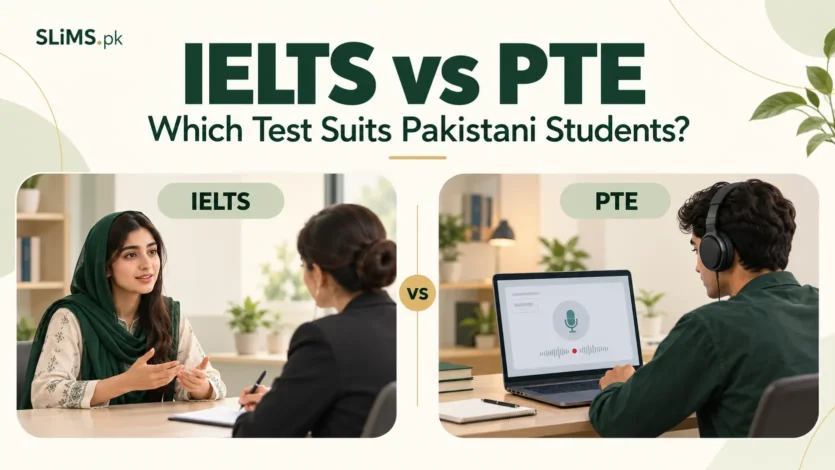
Your friend recommends PTE because the speaking test uses a microphone. Your teacher recommends IELTS because you already know its format. An education consultant says either will work.
Before paying for an exam, you need a clearer answer.
In the IELTS vs PTE decision, choose the test your intended university or organisation accepts, then compare how comfortably you can meet its required scores. IELTS may suit students who prefer a live speaking interview. PTE may suit students who work confidently through timed computer tasks. Neither is automatically easier.
This guide mainly compares IELTS Academic and PTE Academic for Pakistani students applying to universities abroad. It also explains where immigration and professional applicants need to check different test versions.
IELTS vs PTE: The Main Differences
Both tests assess English listening, reading, writing and speaking. Their biggest practical differences are the speaking experience, task structure, scoring and test-day organisation.
| Feature | IELTS Academic | PTE Academic |
|---|---|---|
| Provider | IELTS partners: British Council, IDP and Cambridge University Press & Assessment | Pearson |
| Published test duration | Approximately 2 hours 45 minutes | Approximately 2 hours |
| Speaking | Live interview with an examiner | Recorded responses through a microphone |
| Structure | Four skill sections | Speaking & Writing, Reading, and Listening |
| Score scale | Bands up to 9 | Scores from 10–90 |
| Task experience | Longer reading and writing tasks alongside shorter questions | A variety of short and extended computer tasks |
| Main decision factor | Suitability for your requirements and strengths | Suitability for your requirements and strengths |
The official test descriptions confirm the durations and structures above. Check your appointment instructions separately for arrival time and the speaking schedule.
A shorter exam does not necessarily require less preparation. You still need to understand its tasks and demonstrate the required English proficiency.
Check Acceptance Before Comparing Difficulty
The best test is one that satisfies your actual application requirements.
Start with the course page or offer letter. A university may specify:
- The accepted test and version.
- An overall minimum score.
- Minimum scores in individual skills.
- How recent the result must be.
- Whether a retake result is acceptable.
Check every university on your shortlist. Do not assume that acceptance by one department or institution applies elsewhere.
University Admission and Immigration Are Different
A result suitable for admission may not meet a separate immigration or professional-registration requirement.
For example, Canada’s Express Entry guidance identifies IELTS General Training and PTE Core among its approved English tests. That is a different comparison from IELTS Academic versus PTE Academic for university admission.
Similarly, an application mentioning UKVI requires attention to the exact approved test and route. Do not select an exam simply because its name contains “Academic.”
A useful question to send admissions staff is:
“For this programme and intake, which test versions do you accept, and what overall and individual skill scores do you require?”
Save the response with your application documents.
Is IELTS Paper-Based While PTE Is Computer-Based?
That description is outdated for students comparing current options in Pakistan.
British Council Pakistan lists IELTS on computer and IELTS on computer with Writing on Paper. Availability should be checked for your selected centre and appointment.
Writing on Paper does not mean the entire exam follows the former paper-based arrangement.
This matters if you have spent years handwriting university examinations. You may prefer handwriting, but you should investigate the actual booking options rather than reject IELTS or PTE based on an old comparison chart.
For either exam, practise with the equipment and response method you intend to use. Reading comfortably from a phone is not the same as managing a timed examination on a desktop screen.
Speaking: An Examiner or a Microphone?
Choose the speaking format in which you can communicate clearly under pressure.
IELTS Speaking
IELTS Speaking is a live conversation with an examiner, conducted face to face or through a video call. The published duration is 11–14 minutes.
The practical attraction is interaction. You listen to a person, respond to questions and develop your answers.
This may suit you if you:
- Speak more naturally in conversation.
- Can explain opinions without memorising a script.
- Prefer social interaction to recording yourself.
- Recover comfortably after a hesitant answer.
However, an interview is still an assessment. Being friendly or confident cannot replace answering the question clearly.
PTE Speaking
PTE requires spoken responses into a microphone. Tasks include Read Aloud, Describe Image and other activities with specific instructions.
The updated test includes Summarize Group Discussion and Respond to a Situation, introduced in the 2025 changes. Prepare using current materials that include them.
PTE may appeal if you prefer recording answers without a live interviewer. You must also manage preparation time, recording time and the task instructions.
Try a simple comparison: record a timed response to a sample PTE task, then answer an IELTS-style interview question with another person. Which setting allows you to express your ideas more accurately?
That observation is more useful than someone else’s claim that microphones are easier.
Reading and Listening: Which Format Fits Your Skills?
Both exams require comprehension. Neither becomes easy simply because you know common question types.
Reading
IELTS Academic Reading gives you sustained passages and questions that require careful interpretation. A common preparation challenge is finding relevant information without losing the writer’s meaning.
PTE Reading includes tasks such as completing blanks and reordering paragraphs. These require vocabulary, grammar and an understanding of how ideas connect.
When practising, identify what caused each mistake:
- Unknown vocabulary.
- Misunderstood meaning.
- Weak grammar.
- Poor time management.
- Incorrect use of the interface.
Switching tests may help with format discomfort. It will not automatically fix a limited vocabulary.
Listening
PTE Listening includes varied response types, including summaries, missing words and dictation. Some activities require listening and writing together.
For either test, practise extracting meaning while retaining details. Avoid judging your ability from how comfortably you understand familiar YouTube presenters.
A student who understands a lecture but cannot record names, numbers or key points accurately has a specific practice need. Identify that need before deciding that the other examination must be easier.
Writing: Extended Arguments or Varied Tasks?
IELTS Academic emphasises two substantial writing tasks, while PTE uses several task types involving written responses.
IELTS Academic Writing includes:
- Task 1: describing visual information, with at least 150 words.
- Task 2: responding to an argument, problem or viewpoint, with at least 250 words.
Task 2 contributes twice as much as Task 1 to the Writing score.
Students who can organise an argument and explain evidence may find this structure manageable. Others struggle to develop ideas within the time available.
PTE includes tasks such as summarising written text and writing an essay. You need to respond to the actual content and follow the relevant response requirements.
Do not choose PTE because an academy promises a universal template. A framework can help organise your response, but memorised language that does not address the task is poor preparation.
For both exams, useful feedback explains why an answer is weak. “Use better vocabulary” is less helpful than identifying unclear reasoning, inaccurate grammar or an incomplete response.
Is PTE Easier Than IELTS?
PTE is not universally easier than IELTS. Difficulty depends on your English, target scores and ability to perform the particular tasks.
You may find PTE more comfortable if you:
- Type accurately.
- Follow short, timed instructions well.
- Speak clearly into a microphone.
- Enjoy practising varied computer tasks.
You may prefer IELTS if you:
- Communicate well in a live interview.
- Read longer texts confidently.
- Can develop structured written arguments.
- Already understand the assessment format.
These are starting points, not predictions.
A candidate targeting a modest admission threshold faces a different challenge from someone needing high individual skill scores. “My friend passed PTE quickly” tells you little unless their starting ability and required scores resemble yours.
Does a Pakistani Accent Create a Disadvantage?
Focus on intelligibility, pronunciation and clear communication rather than imitating an unfamiliar accent.
IELTS assesses pronunciation alongside fluency, vocabulary and grammar. Pearson’s task guidance also addresses pronunciation and oral fluency.
Practise word stress, sentence rhythm and clear endings. Speaking unnaturally fast to sound fluent can make your response harder to understand.
How Are IELTS and PTE Scored?
IELTS reports bands; PTE reports scores from 10–90. Their assessment systems should not be treated as interchangeable.
IELTS calculates the overall band from the average of the four section bands, applying its rounding rules.
For example, these hypothetical scores:
- Listening: 7.0
- Reading: 6.5
- Writing: 6.0
- Speaking: 6.5
produce an average of 6.5. However, a programme requiring at least 6.5 in every skill would still identify Writing as below its requirement.
PTE uses automated scoring, with human expert review of some responses before the automated score is finalised. Therefore, describing the current test as involving “no human marking whatsoever” is inaccurate.
For applicants, the important habit is to inspect every required skill score, not just the largest number on the report.
IELTS-to-PTE Score Comparison: Use It Carefully
A concordance table describes a research relationship between scores. It does not set a university’s admission requirements.
Pearson’s July 2025 research provides these overall-score alignments:
| IELTS Academic overall band | PTE Academic overall range in Pearson’s research |
|---|---|
| 5.5 | 39–46 |
| 6.0 | 47–54 |
| 6.5 | 55–62 |
| 7.0 | 63–70 |
| 7.5 | 71–78 |
| 8.0 | 79–85 |
These are overall research alignments, not guaranteed admission cut-offs or individual-skill equivalences.
IELTS also publishes its own comparison research, with different numerical relationships. Always identify the source and version of a conversion table.
Suppose a university accepts IELTS 6.5 or PTE 62, with additional skill requirements. You must meet its stated PTE requirement. A general chart does not authorise you to substitute 55.
Where requirements say only “or equivalent,” ask the institution to confirm the accepted alternative in writing.
Fees and Results in Pakistan
Compare the Complete Cost
IELTS fees vary by test, provider and location. British Council Pakistan’s published schedule reviewed for this article lists:
| IELTS Academic on computer location | Published fee |
|---|---|
| Islamabad | PKR 75,600 |
| Karachi, Hyderabad, Sukkur and Quetta | PKR 75,600 |
| Listed Punjab locations, including Lahore, Multan and Faisalabad | PKR 76,240 |
The schedule is labelled effective from 9 June 2026. Confirm the checkout amount before paying.
For PTE, check the official country-specific fee finder. A live Pakistan quote was not directly verified for this comparison, so an unconfirmed amount should not determine your choice.
Include preparation, payment charges, travel and possible retakes in your budget. A cheaper first booking may offer little saving if you choose a format that requires another attempt.
Which Test Gives Faster Results?
Pearson says PTE results are typically available within 48 hours. British Council Pakistan’s results page indicates 24–48 hours for IELTS on computer, while its booking information uses a broader typical window of 1–5 days.
PTE is therefore not automatically faster than every IELTS appointment.
Check the delivery method, especially if selecting Writing on Paper, and leave time for possible delays. Typical turnaround times are not deadline guarantees.
Retakes: An Important Difference
IELTS One Skill Retake can help eligible candidates improve one section without repeating the full examination.
It requires an eligible original computer test at a participating centre. The retake must be completed within 60 days, and only one such retake is permitted per original test. Crucially, the receiving organisation must accept it.
PTE’s published retake policy describes booking another test after the previous scores are released.
If you narrowly miss one IELTS skill requirement, investigate the accepted retake option before switching exams.
A new format introduces new preparation work. Switching makes more sense when evidence shows a persistent mismatch than when disappointment alone drives the decision.
A Practical Five-Step Decision Process
1. Write Down Your Requirements
Create a small table for each shortlisted institution: accepted version, overall score, skill minimums, deadline and retake policy.
2. Try Official Sample Tasks
Experience both formats before buying a long course. Use current Pearson materials and official IELTS familiarisation resources.
3. Compare Performance, Not Impressions
Check accuracy, timing and response quality. A task that feels pleasant may still expose weaknesses.
4. Get Feedback on Speaking and Writing
Use someone who can explain the assessment criteria. Treat unofficial automated scores as practice feedback rather than guaranteed exam results.
5. Choose and Prepare Consistently
Select the accepted test with the most realistic route to your required scores. Practise your weaknesses and complete timed simulations before booking.
Two Illustrative Student Profiles
Ayesha prefers conversation. She explains ideas clearly in interviews but becomes hesitant when recording timed answers. If both tests are accepted, IELTS deserves serious consideration.
Hamza prefers computer tasks. He types accurately and performs well on varied timed exercises, but a live interview distracts him. PTE may suit him after a realistic trial.
These examples illustrate a decision process; they are not claims about real students or guaranteed outcomes.
Frequently Asked Questions
Neither is easier for everyone. Compare accepted test versions, required skill scores and your performance on timed sample tasks before choosing.
The clearest practical difference is speaking: IELTS uses a live examiner, while PTE records responses through a microphone. Task structure and scoring also differ.
Canada’s Express Entry guidance specifies PTE Core, not PTE Academic, among its approved English tests. IELTS applicants must use General Training. University admission is a separate requirement.
British Council Pakistan lists IELTS on computer with Writing on Paper. Check availability and conditions for the centre and appointment you intend to book.
Pearson’s July 2025 research aligns IELTS Academic overall 6.5 with PTE Academic overall 55–62. This is research guidance; follow the institution’s specific overall and skill requirements.
Eligible candidates can use IELTS One Skill Retake at participating centres within 60 days of the original test. Confirm that your receiving organisation accepts the resulting report.
First identify the cause of the result. Switching may help with format discomfort, but it will not automatically resolve grammar, vocabulary or comprehension weaknesses.
Choose the one in which you can most realistically achieve all required scores within your budget and deadline. Use official practice tasks and informed feedback to make that decision.