

If you are searching for the PEEF scholarship in Pakistan, the first thing to know is this: PEEF supports talented students who need financial help, but the process is not exactly the same for every student. Some students apply through a special quota route, some go through institution-based processes, and master’s students may need to submit through their university office instead of sending forms directly to PEEF.
That is why many beginners get confused. They read one article, see one form, and assume the same process applies to everyone. In reality, the official PEEF system has different scholarship paths, different requirements, and different notices depending on the level and category.
What is the PEEF scholarship?
PEEF stands for Punjab Educational Endowment Fund. Official PEEF pages describe it as a scholarship program that supports talented but needy students. The official site also says that with the inclusion of the 2025 to 2026 cycle, the total number of scholarships awarded rises to more than 505,000.
In simple words, this scholarship helps students continue their studies when money becomes a serious problem. It is one of the most searched scholarship terms in Pakistan because it is strongly connected to real education costs like tuition, books, transport, and student living expenses.
Quick answer: who is the PEEF scholarship for?
This scholarship is usually a good fit for students who:
- have strong marks in their previous exam
- come from a low-income family
- are studying full time
- meet the rules of the exact PEEF scheme they want to apply for
For many official PEEF routes, the common academic benchmark shown is at least 60 percent marks or a minimum 2.5 CGPA, depending on the scheme. Official pages also show a monthly family income benchmark of up to Rs. 60,000 in relevant cases.
You may also like: [Bait ul Maal Scholarship – Complete Annual Guide]
Which PEEF route fits you?
A lot of weak articles treat PEEF like one single scholarship. That is not helpful. A beginner should first identify the right category.
1. Outreach scholarships
Official PEEF pages say that 80 percent of annual scholarships are allocated under the Outreach Scholarships category. These are for needy and talented students under the general PEEF system.
2. Special quota scholarships
Official PEEF pages say that 20 percent of total scholarships are allocated to the Special Quota category. This is for specific groups that need extra support.
3. Master’s level scholarships
PEEF also has a master’s level route. Official pages show that students need to meet the required marks or CGPA, income conditions, and institution requirements. The same page also says that applications for this route should be submitted to designated university offices, not sent directly to PEEF.
Simple comparison table
| Scholarship path | Best for | What matters most | Typical route |
|---|---|---|---|
| Outreach | General needy and talented students | Marks, income, full time study | Official institutional route |
| Special Quota | Students in reserved categories | Category proof plus eligibility | Online registration |
| Master’s Level | Students in eligible universities | Previous marks or CGPA, income, university route | Submit through designated office |
Basic eligibility explained in simple words
Most students want a straight answer, so here it is.
You are more likely to qualify if:
- you meet the minimum marks or CGPA requirement
- your family income falls within the limit for the scheme
- you are enrolled as a full time student
- you are not already taking another major educational scholarship in the same academic year
- you meet any domicile or category conditions for the route you are applying under
This does not mean every student with 60 percent marks gets selected. It means you may fall within the basic eligibility range. Final selection depends on your full case, your documents, and the exact scholarship cycle.
Special quota categories you should know
The Special Quota route is not a small side option. It is a major part of the scholarship system.
Official PEEF pages show special quota support for categories that include:
- orphan children
- children of government servants in BPS 1 to 4
- minority students
- children of civilians martyred in terrorist attacks
- children of divorced mothers
- special children or disabled students
This is important because category proof matters. If you apply under a special category, your supporting documents must clearly match that category.
Special Quota Scholarships
PEEF reserves awards for special categories, including:
- Orphans
- Children of govt employees (BPS 1–4)
- Minority students
- Disabled students
- Children of terrorists’ victims
- Children of divorced mothers
These quotas ensure students who face extra challenges get supported.
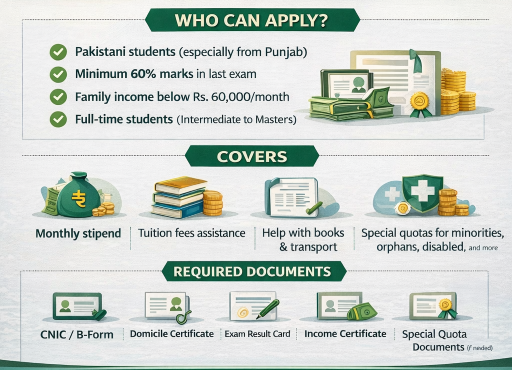
What does the PEEF scholarship usually cover?
Most students ask this right away. They want to know if PEEF only pays tuition or also helps with other expenses.
A practical way to explain it is this: PEEF is meant to reduce the financial pressure on deserving students so they can continue studying. The exact financial support can vary by scheme and cycle, but the purpose is to support education costs for needy and talented students. Official PEEF pages consistently present it as a scholarship support program rather than a simple one-time certificate or award.
Documents you should prepare before opening the form
Do this first. It saves time and helps you avoid mistakes.
Keep these ready:
- student CNIC or B Form
- parent or guardian CNIC copy
- domicile
- latest marks sheet or transcript
- admission letter or proof of enrollment
- income affidavit or income certificate
- category proof if applying under special quota
- recent passport size photo if the current form asks for it
A very common beginner mistake is starting the application before collecting documents. Then they stop halfway, guess details, or submit incomplete information.
A better way is to scan everything first and keep one folder on your phone or laptop.
How to apply without getting confused
If you are applying under special quota
Official PEEF results show a dedicated Special Quota Scholarship Online Registration 2025 to 2026 route. That means special quota applicants should follow the official online system rather than random screenshots shared on social media.
If you are applying for a master’s scholarship
Official PEEF pages say that master’s applications should be submitted to designated university offices and that applications sent directly to PEEF are not entertained. This is one of the most important details for university students.
If your institution handles part of the process
Ask your college or university three questions:
- What is the last internal submission date?
- Which office receives the form?
- Which documents need attestation?
This one small step can save you from missing the real deadline.
Common mistakes that get students rejected
Most students do not lose their chance because they are weak students. They lose it because of simple mistakes.
Here are the most common ones:
- choosing the wrong scholarship category
- entering wrong marks or personal details
- uploading incomplete documents
- using weak or mismatched income proof
- sending forms to the wrong office
- relying on old Facebook posts or WhatsApp forwards
- waiting for the final day
Official PEEF news pages show scholarship notices by specific cycle and date, which is why old advice can quickly become outdated. The official news page includes a Special Quota Scholarships 2025 to 2026 update dated September 29, 2025.
Related reading: [Dalda Foundation Scholarship 2026: Eligibility Criteria & Application Procedure]
Real examples for beginners
Example 1
A student from Punjab gets 72 percent in Matric, belongs to a low-income family, and takes admission as a full time student. This student should check the regular PEEF routes because the case looks close to the type of profile PEEF is designed to support.
Example 2
A minority student has the required marks but does not collect category proof early. Even if the student meets the academic condition, the application may become weak because the category claim is not fully supported.
Example 3
A university student starting a master’s degree meets the CGPA condition and income rule. This student should not randomly post a form to PEEF. The better step is to contact the designated university office first because that is how the official route works for master’s level scholarships.
Deadlines change, so do this instead of trusting old posts
Many scholarship articles make one mistake. They publish one date and leave it there forever.
That is risky.
PEEF notices change by cycle. The better habit is:
- check the latest official PEEF news
- check the scholarship page for your category
- ask your institution if it has its own internal deadline
- prepare your documents early
Final checklist before you apply
Before submitting your application, ask yourself:
- Did I choose the correct PEEF route?
- Do my marks or CGPA meet the scheme rule?
- Is my income proof complete?
- Did I attach the right category proof if needed?
- Am I using the correct official source?
- If I am applying for master’s level, did I submit through the right university office?
- Did I check the latest notice?
If all of these are clear, your application is already much stronger.!
FAQs About PEEF
Q1: Who can apply for PEEF scholarships?
Students with Pakistani citizenship — especially Punjab residents — who meet academic and income criteria.
Q2: What percentage do I need to qualify?
Typically 60% marks or equivalent CGPA in your last examination.
Q3: Does PEEF cover full tuition?
PEEF offers tuition assistance and monthly stipends, but the exact coverage depends on the scholarship category.
Q4: Are there quotas for special groups?
Yes. PEEF has special quota scholarships for orphans, minorities, disabled students, and others.
Q5: Where can I find the application form?
Download it from the official PEEF website or get it from your institution’s financial aid office.